
Brussels is closer than you think!
New beginnings are an opportunity to look back at everything that marked the past year.
For me, 2025 was the first full calendar year of our first term as an MEP in the European Parliament. Since the beginning of my term in the European Parliament, I have been a member of the Committee on Regional Development (REGI), Committee on Employment and Social Affairs (EMPL), Committee of Petitions (PETI), and in 2025, with the establishment of the Special Committee on the Housing Crisis in the European Union (HOUS), I became its member and Coordinator of the Greens/EFA group for housing issues.
Why this is important for Croatia: These are committees that cut out the rules and priorities for the allocation of EU funds and standards that spill over into our housing, workers' rights and how citizens can rely on the EU when a state or local authority breaks the rules.
This year, I was a shadow rapporteur for the Greens/EFA Group on two reports in the Committee on Regional Development (REGI):
Both texts were adopted with the acceptance of a number of my amendments.
Why this is important for Croatia: REGI's work is not an “abstract Europe” but a political compass for how cohesion funds can and should be used. When the European Parliament pushes for the opening of the Cohesion Fund affordable housing it is direct leverage for Zagreb and other cities which are bursting under inflated prices and tourist pressure. When pushing for a just transition it is a safety net for regions and jobs in the transition to renewable energy and a greener industry so that the cost of change does not fall on the backs of citizens.
Also, within the Committee on Regional Development, I have consistently advocated for Direct financing of cities with EU funding and in this direction several of my amendments were adopted.
Why this is important for Croatia: “Directly to the cities” means fewer bottlenecks, less political filtering and more chances for local projects (housing, kindergartens, public transport, energy renovation, neighborhood infrastructure) to get money faster and with clearer criteria. It is also an antidote to centralization where too much depends on goodwill from the state level.
Within the Committee on Employment and Social Affairs, as shadow rapporteur for the revision of Regulation 883 on the coordination of social security systems, I advocated for increasing the social rights of mobile workers working in other EU Member States. I was also the shadow rapporteur on the gender pay and pension gap in the EU in the same committee. I was also actively involved in the discussion of inappropriate working conditions in Amazon warehouses in Europe.
Why this is important for Croatia: Tens of thousands of people from Croatia work in other EU countries and in such cases very specific questions arise - who pays contributions, how is seniority recognised, what about unemployment benefits, sick leave and family rights? The coordination rules of Regulation 883 are an “operational constitution” for mobility workers and any strengthening of rights is protection against the existing loopholes in the system and against exploitation. Also, gender gap in wages and pensions is not a statistical footnote but is very realistically manifested in career breaks, unpaid care and occupational segregation. My contribution to the EP work on this subject is pushing measures that should cut through “normalised injustice” in wages and the devaluation of female-dominated jobs.
Within the Petitions committee, which allows all citizens of the European Union to address the European Parliament directly with their complaints (petitions) pointing to violations of rights guaranteed by EU law. It is thanks to one such petitioner, a pensioner from Germany, through which I launched an initiative to strengthen the rights of pensioners throughout the European Union. It is “retirement card” project, which would provide all pensioners with standardised discounts across the EU and thus, at least symbolically, say thank you to the generation that built the European Union we live in today. Although the initiative is still in its infancy, it has been embraced by political groups from across the spectrum, which is indeed a rarity in this term and a reason for optimism.
I was also clear and loud throughout 2025 supporting the civic initiative“My Voice, My Choice”, which was launched precisely through this Committee, through the mechanism of the European Citizens' Initiative. This mechanism makes it possible to change EU legislation by collecting one million signatures from the citizens of the European Union. Accessible and safe abortion in the EU is well on its way to become a reality in 2026, thanks to the incredible energy and strategy of activists who have done the lion's share of the job to put this issue at the top of the political agenda.
As part of the Special Committee on the Housing Crisis in the EU I initiated the sending of a letter to the European Commission requesting that urgent measures should be taken to respond to the growing housing crisis in the EU. I have invited the people of Croatia to send me their proposals concerning the crisis institutions, which will help form the report of this Committee, and on that basis prepared amendments on the first draft of the report advocating for strengthening of the financing of public, social and affordable housing, greater control of short-term rentals and the taking of measures to curb the further financialization of housing.
Why is it important for Croatia: The Croatian coast is a laboratory of short-term rental, and Zagreb is a laboratory of price growth, where we are developing and strengthening the system of public housing supply. If the EU starts to take financialisation and tourism more seriously as a political problem, it will strengthen the capacities of the cities and countries that want protect housing as a right, not as a semi-profit.
In addition to other members, I was a co-author two proposals for foreign policy resolutions - about “Polarization and Increased repression in Serbia one year after the tragedy in Novi Sad.” and ”The breaking point of Gaza: EU action to fight hunger and the urgent need to release hostages and move towards a two-state solution. Together with a dozen other fellow Members, I organised the first press conference in the European Parliament on the genocide in Gaza.
I have been actively involved in supporting and struggle to strengthen the voice of Serbian students in the European Union - welcoming Serbian cyclists in Strasbourg and student runners in the European Parliament, organizing round tables on this topic, regular participation in Serbian media and giving three speeches at the plenary session in Strasbourg on the topic of the situation in Serbia.
In Hungary this summer I defended our colors as a part of the European Parliament delegation of the Greens on the banned Pride parade which is in Budapest attracted even 100 thousand people in the struggle for civil liberties.
Why this is important for Croatia: In short - one world, one fight.
In 2025, I held 20 speeches in plenary sessions in which, among other things, I touched on:
During the year, I instructed 8 written questions to the European Commissionin which the focus was on the following topics:
I tabled over 100 Amendments upon various documents of which the least quarter was accepted - either through negotiations or through voting.
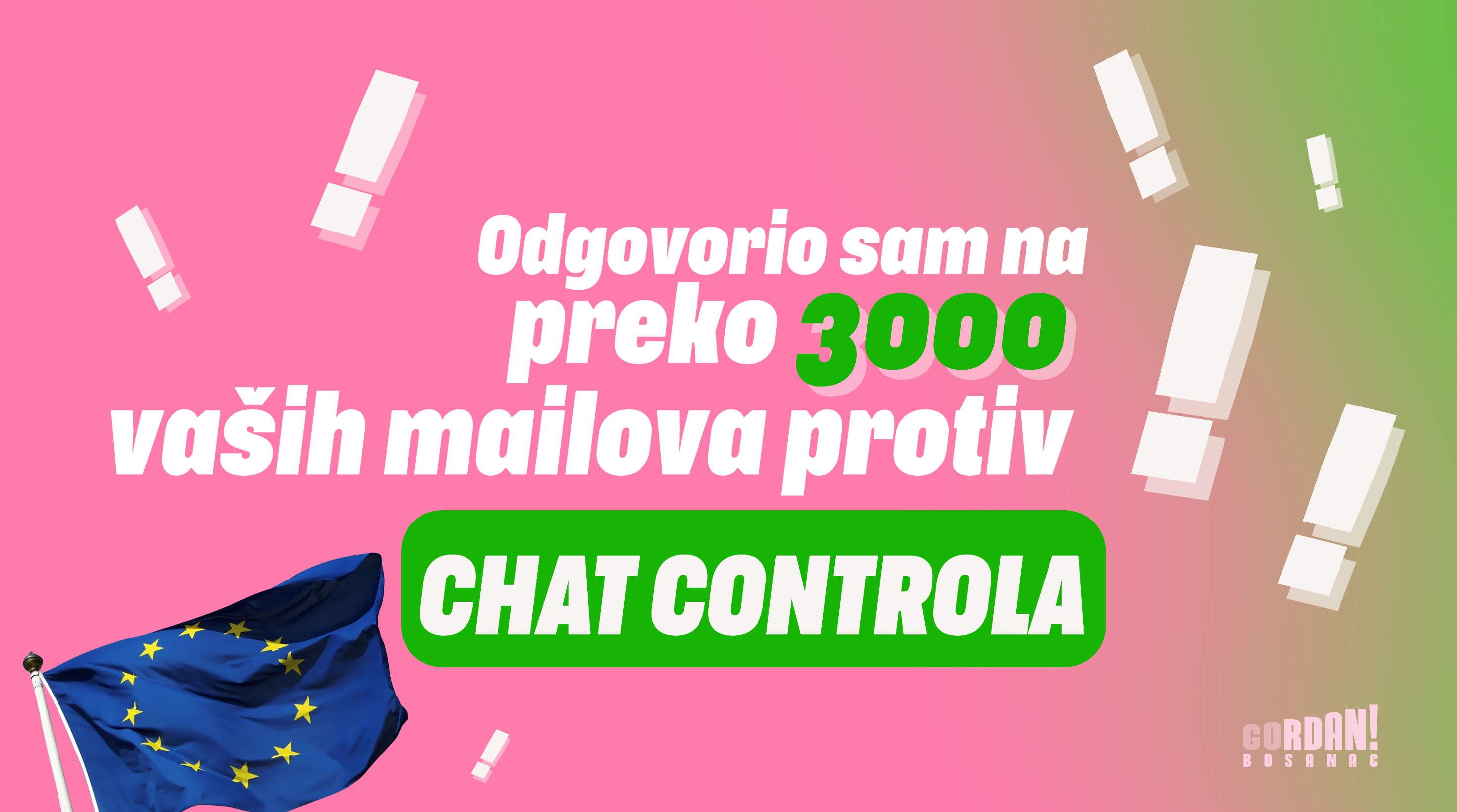
Finally, in 2025 I answered 3,000 questions from concerned fellow citizens on the topic chat controls from surveillance of private communications, in which I clearly communicated the position of Možemo! as an opponent of the untargeted, all-out surveillance of our cell phones by the repressive apparatus. Also, I held over 40 meetings with different organizations, civil society and representatives of the business sector on various topics and hosted two groups of visitors from Croatia to the EP.
Why this is important for Croatia: EU debate on controlled chat is formally related to the fight against child sexual abuse, but in practice it raises the issue of mass surveillance and privacy. It is a classic terrain where good intentions easily become a bad precedent, and it is important that Croatian citizens have clear allies who know how to distinguish the protection of children from the industrialization of surveillance.
In summary - a year full of work on policies that would facilitate and improve living conditions in the member states of the European Union, which are immensely important for Croatia. In my work, I was guided precisely by the problems that are recognized as burning in Croatia and the solution of which European regulation can contribute, while fighting for the preservation of European values.
I wish you all a lot of success in the new 2026 and as much good news from Europe as possible!






.png)
.png)